
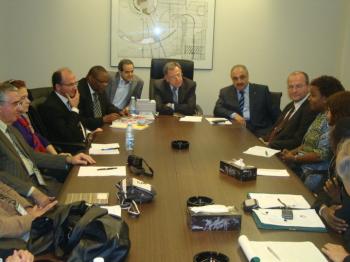
At 10:30 a.m. Tuesday, November 23, 2010, the Global Partnership for the Prevention of Armed Conflict (GPPAC) conducted a visit to Lebanon’s former President and current President of the Lebanese Phalange Party(Al-Kataeb) Amin Gemayel at his mansion in Bikfaya. Mr. Emmanuel Bombande; President of GPPAC and coordinator of the Partnership in South Africa spoke on behalf of the entire delegation, in the presence of Mr. Fadi Abi Allam, President of the Permanent Peace Movement (PPM), Ms. Hala Sakr, Regional Co-ordinator of the Global Partnership in the Middle East and North Africa (MENA), and a number of international initiators representatives of the 15 regional networks of GPPAC distributed around the world.
After introducing GPPAC and its delegation, the meeting was opened with a brief of GPPAC’s conference objectives in Beirut. Mr. Gemayel, then gave a talk about the party’s experience and its vision
with regard to the political violence in the Middle East in general and Lebanon in particular, and the need of such initiative for the entire region to preserve civil peace in Lebanon and the neighbourhood. Gemayel also discussed the importance of achieving social justice and security dissemination and stability under the rule of law. He said: "We cannot achieve peace without justice first, and in Lebanon, we cannot achieve that justice alone since we hold ideological variance among us, for that reason we need the help of external efforts to achieve such justice." He also added, "We should not forget that Lebanon is also exposed to some external pressures, however, we cannot strip Lebanon from its surrounding even if the country is affected by political violence because of its surrounding." He added that Al-Kataeb is an initiator on this front in order to achieve political and economic stability in Lebanon.
According to Gemayel, Lebanon is complex in its composition, every political party has a contrasting political vision, but this is what distinguishes Lebanon from other countries in the region, it draws the balance between justice, democracy and resistance against the external enemy.
Gemayel adds: "No one can find a radical solution to the political crisis in Lebanon, it does not matter how many political parties Lebanon encompass, what matters is the crisis we are living with under these various political ramifications, especially that most of them are dependent on the outside”.
Gemyal concluded that despite all these difficult circumstances, Lebanon remains a home for all and everyone should seek to achieve justice and democracy in order that all Lebanese receive equal life under the rule of law and a sole nation.
At 2:30 p.m., another meeting was held with MP Ghassan Moukheiber. Mr Mokheiber is close to the Change and Reform Bloc led by former General, MP Michel Aoun. The MP did not deny the political and sectarianism ramifications which lead to a confusion in understanding of the political structure in Lebanon. He says: " There is a misunderstanding of the Lebanese internal politics as everyone thinks that the Lebanese are only divided between ‘14 of March’ or ‘8 of March’, but the truth is that there are many who falls inadvertently between the two. For example I am an MP and I am not part of any group of these two! "
He added: “political parties may differ in various matters, but there is much were they agree upon like the restoration of democracy, justice, and peace for all.” Mr. Moukheiber also pointed to the Palestinian issue in Lebanon stating that giving civil rights to the Palestinians refugees is a duty of all.
As for the army’s arsenal he said: “How can we defend the nation with no adequate weapons to the Lebanese army?” Mr. Moukheiber concluded his speech by saying that in order to achieve justice; everyone must be given the right to exercise citizenship in this country as well as defending its land and people against the Zionist entity.
At 5:00 p.m., the GPPAC held its third meeting of the day by visiting Minister Hussein Hajj Hassan, as a representative of Hezbollah, at his office at the Ministry of Agriculture. The Minister confirmed that Hezbollah has the right of resistance and the right to maintain its weapons in order to fight the only enemy to the region (Israel). He also spoke on the role of foreign policies intervention in the region’s affairs as to disarmament of weapons.
Hajj Hassan said that Hezbollah is not a terrorist organization, Hezbollah is a Lebanese party who has the right of existence as long as Lebanese territories are still under Israeli occupation.Finally he spoke on the Special Tribunal for Lebanon (STL), assert that Israel is the only beneficiary of Hariri’s assassination and also Israel has the physical and political potentials for the assassination.
The last visit was a meeting with former PM Fouad Siniora, who spoke about Lebanon’s history and its position in the East and West. He also spoke about the importance to reach a permanent peace in the region since this peace is significant to the stability of nations.
Siniora also spoke about globalisation and how it broke the barriers between states and made us all affected by its risks since the media has made communication closer in both time and space.
He also talked about King Abdullah’s peace initiative in 2002, which its prospects were collapsed after Israel has twisted it from ‘land for peace’ to ‘peace for land’, and how Israel, as usual, since 1991 never complied by the UN’s initiatives, but still building settlements on the Palestinian land.