
A- Description of the sessions:
On February 2011; the training sessions started in 8 UNRWA schools by the second week of February 2011; 3 sessions were given to each class, in grades 7 and 8 in Samakh, Al Manara, Batteer, Jordan River and Gaza schools -NBC, Majeddo and Mazar schools -BC and to grade 6 in Jabal tabour school-NBC.
In these sessions; PPM trainers reviewed all the topics that were tackled with the students during the last scholastic year in May, June, half of July 2010 and December 2010 in order to refresh their minds and to continue the rest of our psycho-social program smoothly and chronologically. The tackled topics were about communication skills, dialogue, setting goals, self-confidence, self-esteem and an introduction about stress management. The sessions were given to 991 students on weekly basis; 518 boys and 473 girls. And at the end of February-beginning of March a Pre-Questionnaire was filled by the students in order to evaluate their behaviors and attitudes towards the given topics.
On March 2011;5 weeks of training sessions was given to the 991 students in all UNRWA schools; 518 boys and 473 girls.
In these sessions; PPM trainers talked about violence, how to deal with it and the non-violent ways in dealing with conflicts. After giving these sessions; we noticed that the students got more involved in the program and started participating more.
And a meeting with Head of Teachers was held on the 12th of March 2010 in Quality-Inn hotel in Tripoli.
· Topics, implemented activities and Objectives of training sessions given in March 2011:
|
Topics |
Implemented activities |
Objectives
|
|
1-Violence, Anger and stress.
2-Non Violent means in dealing with conflicts. |
1-Brainstorming about Violence- Anger- stress.
2-Exercises: Play Roles- and how to deal with violent situations and with stress and anger.
3- Evaluation |
1-To learn how to identify the needs of the other before having an aggressive reaction. 2-To analyze the reasons behind anger and stress and to know how to react positively. 3- To raise awareness about the negative effects of Violence. 4-To explore problem solving strategies and techniques. 5- To know that a conflict could be an opportunity.
|
· Meeting with the HTs of UNRWA schools:
For a smoother intervention especially after December’s incident in Gaza school; a meeting for the Head of Teachers was held in Quality Inn Hotel in Tripoli on Saturday the 12th of March 2011; where all UNRWA HTs and the representatives of UNRWA, MDG-F program, UNICEF and PPM shared their different point of views concerning the implementation of the project and how to benefit from this project for the wellbeing of the Palestinian youth.
PPM’s intervention:
Mr.Fadi Abi Allam-President of PPM- interfered and clarified the concept of “Peace” into the Palestinian context and with UNRWA students. The participants responded very well and were released from any misunderstanding.
The participants’ recommendations and Action plans:
- Share with the Directors of the schools the training modules for their feedback (keeping in mind that the module was already shared and approved by UNRWA Education Unit)- It was effective since May 2010.
- Propose to UNRWA Head Office an exchange visit between the directors of the UNRWA schools and the directors from the Public Schools.
- Review the weekly training session plan with directors in order to try scheduling the training session outside school hours- We tried to apply it but we couldn’t due to logistical obstacles and the double shift in each school.
- Ensure the presence of a teacher in the classroom during the training sessions- It was effective since December 2010
- Considering that there is a need for some children to get follow up by psychological experts, a referral plan for children in need of psychological follow up with concerned organizations should be defined- A small referral system was prepared; but needs to be more developed!
The discussion ended with an overall agreement to invest all the efforts possible to make this project a successful one, which will open the door for other similar initiatives.
On April 2011;3 weeks of training sessions was given to the 991 students in all UNRWA schools; 518 boys and 473 girls.
In these sessions; PPM trainers talked about Environment, Land Day and community work/civic participation and about Conflict: Prevention, transformation and resolution.
In this month; the activities were so interesting and alive especially in the Land Day; where the students and the administration of the schools showed a lot of appreciation and cooperation.
By starting the “Conflict” topic, small “Mediation Committees” were established in almost all the classes in order to contribute practically in solving the problems inside the class and with the teachers and the administration.
|
Topics |
Implemented activities |
Objectives
|
|
Civic participation: Environment- “Land Day” (2 sessions) |
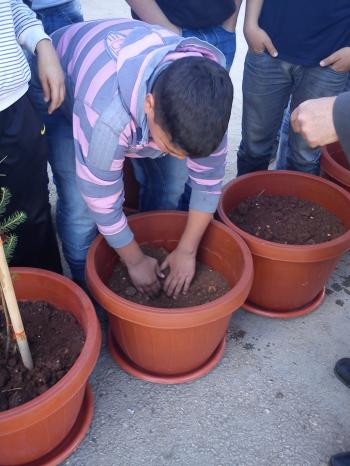
1-Planting a tree for each class on the occasion of “Land Day” “Planting is an act of putting down roots and contributing to the future”. The “land Day” is an annual day of commemoration for Palestinians of the events of the date in March 1976 when the Israeli government announce a plan to expropriate thousands of Dunams of Palestinian’s land for "security and settlement purposes" so it means so much to UNRWA students. 2-Competition about environment and pollution/ in the play-ground. 3- Distribution of gifts for the winners of the drawing competition in BC schools and for the winners of the environment competition in NBC schools. (gifts were puzzles and scrabbles) 4-A recycling box for papers in each administration/ HT's room sponsored by Sanita- with the logo-عناتيضل الحلا (and we contacted Tissue Mill to collect the papers on monthly basis from the schools). 5- Evaluation |
1- To spread environmental awareness. 2- To encourage students participate in environmental activities in their communities/ Civic participation 3- To help the students express their opinions and feelings about the “Land Day” and its importance for them as Palestinians. 4- The gifts aimed to encourage the students learn more about environment and dare to participate openly in community work. 4- The recycling box in the HT’s room aimed to involve the administration of UNRWA schools in the activity and to encourage all the teachers and HTs to participate in our project. |
|
Conflict:Prevention, transformation and resolution (2 sessions) |
1- Brainstorm about conflict/ it could be a “danger” and it also could be an ”opportunity” 2- Exercise: Role play- acting 3 roles with 3 different attitudes in each group: The aggressive one, the irresponsible one and the firm one.
|
1-To define conflict and think about the reaction the participants have when they face a conflict. 2-To help the students think how to make a conflict an opportunity. 3-To raise awareness about the 6 peaceful means of conflict resolution. |
B- The role of “Conflict Resolution” Committees/ Some incidents inside the classes:
The “Conflict Resolution” committee is an initiative from the project formed by 3 students from each class. The idea of “Conflict Resolution” committee started the beginning of April when we started training the students about conflict prevention, conflict transformation and conflict resolution. Many active committees were settled in Majeddo, Mazar and Gaza schools. The role of these committees was to identify the real reasons behind the conflicts that are happening inside their classes (between 2 students or more- between a student and a teacher…) and the students were so happy to refer their problems to theses committees.
While one of PPM trainers was giving a training session in the grade 7B in Majeddo School- Beddawi Camp; a student hit violently his friend and then suddenly a violent attack occurred in the class where all the students participated in less than 2 minutes. The school's principal personally intervened to solve the conflict. He was helped by the conflict resolution / mediation committee. It was simply a misunderstanding and after discussing the issue with the class and the trainer, the 2 students were reconciled and the director of the school suggested fixing a session where we will reset the rules and laws of the class.
While one of PPM trainers was giving a training session in the grade 8A in Gaza School- Nahr el Bared Camp; a group of girls started teasing a girl and making fun of her for answering a wrong answer in the discussion group in front of all the class. And then the discriminated girl started insulting the groups and started describing them with bad words. The trainer intervened and tried to take advantage from what’s happening and asked for the assistance of the “Conflict Resolution Committee”. At the end, the problem was solved and they both apologized from each others.